In 2026, Slovenian biologist and wilderness survival practitioner Dr Žiga Ogorelec won Alone Season 13, the World Championship edition, after spending an extraordinary 90 days alone in the Canadian Arctic.
For many viewers, Žiga was a relatively unfamiliar face. Unlike some of his fellow contestants, he didn’t arrive with a substantial international media profile or a large online following.
But he was certainly no newcomer to wilderness survival.
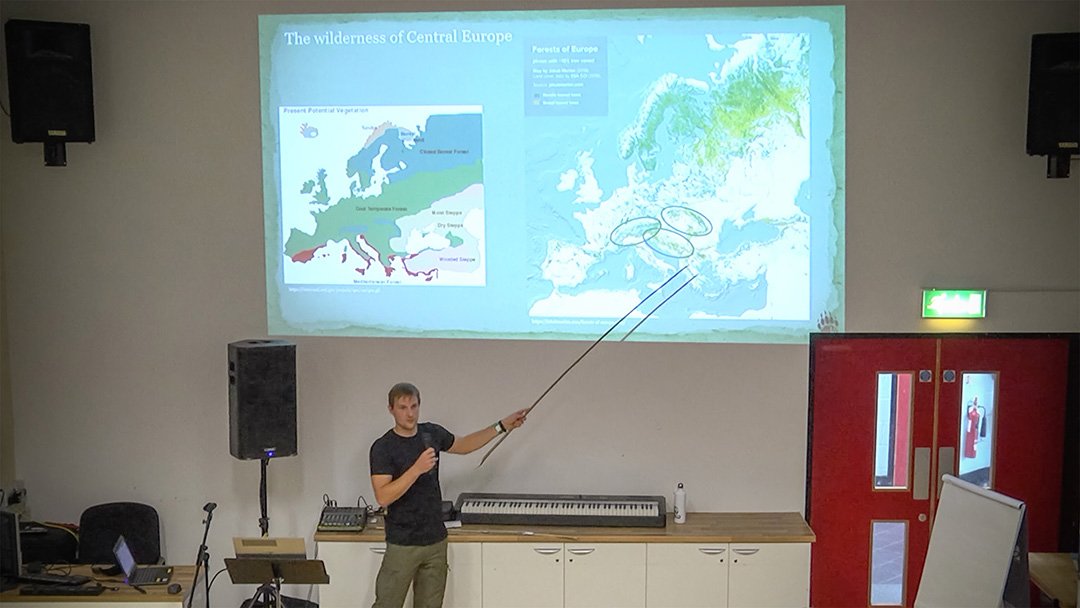
Four years earlier, in July 2022, Žiga travelled to Wales to speak at the Global Bushcraft Symposium (GBS), where he delivered a fascinating presentation entitled Living Off the Land in the Wilderness of Central Europe.
At the beginning of his talk, he even joked about his relative obscurity. Referring to a question Paul Kirtley had asked the audience at the previous symposium in 2019 about how many people had never heard of him, Žiga suggested that he didn’t need to ask the same question. He already knew that practically everyone would raise their hands!
Looking back, it’s a particularly enjoyable moment.
With Žiga’s subsequent success on Alone, we’re delighted to make his complete 2022 symposium presentation freely available. Watch the full presentation below and explore the ideas that shaped his approach to wilderness living.
The talk offers an opportunity to explore the scientific understanding, practical experience, and approach to wilderness living that Žiga developed long before appearing on television.
Watch Dr Žiga Ogorelec: Living Off the Land in the Wilderness of Central Europe
In this presentation, Žiga examines a deceptively simple question: can a person really sustain themselves by obtaining all their food from the wilderness of Central Europe?
Drawing on his scientific background and years of practical survival experience, he explores the geography and ecology of Europe’s remaining wild areas, the availability of natural foods, human energy requirements, traditional survival practices, and the challenges of living entirely from what the landscape provides.
Rather than offering a catalogue of survival techniques, his presentation considers the underlying ecological and physiological factors that determine whether living off the land is actually feasible.
Who is Dr Žiga Ogorelec?
Žiga grew up in Slovenia’s Kočevje region, an area known for its extensive forests and populations of brown bears, wolves, and lynx.
He holds a PhD in biology and has worked in scientific research, including studying fish. His scientific background has given him a particular interest in bioenergetics, food webs, ecological productivity, and the carrying capacity of natural environments.
Alongside his scientific career, Žiga has spent many years developing and testing practical wilderness skills. Together with his brother Miha and other colleagues, he established Gozdovništvo, a Slovenian bushcraft and survival school. Their activities have included traditional crafts, primitive technologies, survival courses and increasingly demanding wilderness expeditions.
One of Žiga’s most significant experiences before Alone was a 15-day solo journey across 270 kilometres of Slovenia, during which he obtained all his food from the wild. During his 2022 presentation, he explained that he lost about eight kilograms over the expedition, despite spending considerable time finding and preparing food.
You can read more about Žiga’s background, expeditions and wilderness survival experience in his original GBS 2022 speaker biography.
The wilderness paradox: Why the wildest places aren’t always the best places to survive
One of the most interesting arguments in Žiga’s presentation concerns the distribution of wilderness in Central Europe.
Although Europe retains some extensive natural landscapes, many of its most remote areas are found in mountainous regions, including the Alps, Dinarides and Carpathians.
These landscapes may appear ideal for wilderness survival, but their remoteness does not necessarily make them productive sources of food.
Žiga points out that human settlement historically concentrated in relatively fertile, accessible areas, particularly around rivers, lakes and productive lowlands. Many of the places that remained comparatively uninhabited were precisely those where obtaining food and sustaining human life was more difficult.
Consequently, searching for the most remote and apparently untouched forest may not be the best strategy for someone attempting to live off the land.
He also explores the importance of habitat diversity.
An extensive forest dominated by a small number of tree species may provide fewer accessible food resources than a landscape with a mix of woodland, grassland, clearings, streams, and wetlands.
Using the example of beavers, whose activities create complex mosaics of aquatic and terrestrial habitats, he explains how habitat diversity can support a greater range of plants and animals.
Žiga also draws an interesting comparison between humans and bears. As large omnivores, both can benefit from landscapes offering a variety of foods across different habitats.
The underlying lesson is that understanding how an ecosystem functions is fundamental to evaluating its potential for human subsistence.
Edible doesn’t necessarily mean worthwhile
A substantial part of the presentation concerns the nutritional value of wild foods.
Knowing that a plant or fungus is edible is one thing. Knowing whether it can provide sufficient energy to sustain someone over an extended period is another matter entirely.
Žiga compares different categories of wild food, including green plants, mushrooms, fruits, nuts, roots, tubers and animal foods.
He shows that many familiar edible plants contain relatively little energy for their weight and volume.
Leafy vegetation and mushrooms, for example, may be abundant in certain seasons, but the quantities required to satisfy daily energy requirements would be impractically large.
Nuts, seeds, and certain carbohydrate-rich underground plant parts offer considerably more potential as energy sources.
However, even apparently valuable resources must be considered in terms of their availability, seasonality, processing requirements and the effort involved in obtaining them.
Žiga also discusses the importance of mast years, when trees such as beech produce exceptionally large quantities of seeds. These events can influence not only the availability of plant foods but also the populations of animals that depend upon them.
His discussion of the traditional Slovenian practice of dormouse trapping provides a particularly interesting example of how local subsistence knowledge has developed around these ecological relationships.
Throughout the presentation, a recurring question emerges: does obtaining and processing a particular resource provide a worthwhile return for the energy invested?
It’s a question that goes well beyond recognising edible species, and one that becomes increasingly important when someone must meet their daily nutritional requirements entirely from the landscape.
From knowing survival skills to living off the land
Žiga’s understanding of wilderness survival has been developed through repeated practical experience.
In his talk, he describes how he and his companions began undertaking expeditions without carrying food, initially spending four days in the forest.
Their first attempt was difficult enough that they considered giving up. Eventually, however, they found productive areas with fish and edible plants, allowing them to complete the experience.
Following that first expedition, they continued to develop their skills and gain more experience of living off the land. Each year, they made their expeditions a little more challenging, spending longer periods in the wilderness, taking less equipment, and experimenting with different conditions and times of year.
These experiences taught them not only what they could get from the landscape, but also what was realistically worth pursuing.
For example, Žiga discusses the considerable time and effort required to manufacture primitive hunting weapons and questions whether such activities represent an effective use of limited energy in a real subsistence situation.
Similarly, his discussion of fishing emphasises understanding the behaviour and ecology of different fish rather than relying on techniques without considering the species being targeted.
Even apparently abundant resources can prove disappointing. During the audience questions, Žiga recalls how enthusiastic he and his companions initially were about finding edible mushrooms. But when eating them without the calorie-rich accompaniments normally used in everyday cooking, they quickly discovered their limitations as a source of sustenance.
These are the sorts of observations that emerge from actually attempting to live off the land, rather than simply demonstrating individual survival techniques.
Traditional knowledge, scientific understanding and practical experience
Another interesting aspect of Žiga’s presentation is his consideration of traditional survival knowledge in Central and Eastern Europe.
He discusses regional practices, older Slovenian and Yugoslavian survival literature, and how knowledge of wild resources was historically associated with people who depended on them out of necessity.
Some of this traditional knowledge has survived, but much of it has been lost over time or is now scattered across different sources.
Žiga also points out that some survival books describe techniques that the authors themselves may never have tried, raising questions about how effective those methods are in practice.
His own approach draws on his scientific background, an understanding of traditional practices, and many years of testing skills and techniques in the field. At the same time, he recognises that there are still questions about living off the land for which he doesn’t have satisfactory answers.
When discussing the nutritional value of certain fibrous plant materials, for example, he raises questions about the relationship between their potential energy content, the effort required to process them and how much energy the human body can actually obtain through digestion.
Rather than presenting a definitive answer, he invites further discussion with others who might have relevant expertise.
This willingness to question assumptions and examine the limits of existing knowledge is one of the particularly valuable features of his presentation.
Living off the land and appreciating nature
Žiga concludes his presentation with a broader reflection on what wilderness experiences can teach us, and by drawing a connection between wilderness living and conservation.
He argues that the direct experience of obtaining food, shelter and other necessities from the natural world gives us a deeper appreciation of nature, as well as the conveniences of modern life.
He also makes an important distinction between the responsible use of natural resources and the longer-term damage caused by habitat fragmentation, development, pollution and invasive species.
Ultimately, his presentation is not simply about whether someone can survive in the forest. It’s also about what we can learn from trying.
It is an appropriate conclusion to a presentation that treats wilderness survival not merely as a collection of techniques, but as an exercise in understanding how humans interact with natural ecosystems.
From GBS 2022 to Alone World Champion
Four years after giving this presentation, Žiga Ogorelec went on to win Alone Season 13, surviving 90 days in the Canadian Arctic.
The environment and circumstances differed from those he discussed at the 2022 GBS, and no single presentation could fully capture the granularity of personal experience.
Nevertheless, looking back at Žiga’s talk offers valuable insight into the knowledge, practical experience, and ways of thinking he brought to the challenge.
If you first encountered Žiga through Alone, we hope this recording gives you a chance to learn more about his background and the experience he drew on during the “World Championship”, as the show producers framed it.
More from the Global Bushcraft Symposium 2022
The Global Bushcraft Symposium 2022 brought together bushcraft, survival and wilderness skills practitioners, instructors and researchers from around the world to exchange knowledge, share experience and explore approaches to wilderness skills education.
Žiga’s presentation was one of many covering a broad range of practical, educational and cultural perspectives.
If you enjoyed his talk, you can also explore the collection of recorded presentations from GBS 2022, via the link below.
Get recordings of the 2022 Global Bushcraft Symposium Presentations